

Have you ever been asked what you’re thankful for when what you really needed was someone to ask how you were doing?
November arrives with lovely reminders to appreciate our lives. Around Thanksgiving, gratitude can become part of the conversation at every turn. And sometimes that feels welcome. There are people we love, kindnesses we remember and traditions we’re glad to share.
Other times, the question lands awkwardly.
Perhaps you’re missing someone. Perhaps you’re worried about money, tired of being the person everyone relies on, or adjusting to changes you didn’t choose. You may enjoy your family and still feel overwhelmed by the plans. You may have plenty you appreciate and very little energy left to express it.
You don’t need to resolve those feelings before you’re allowed to notice something good.
Our November theme, A Season to Savor, makes room for the day you’re actually having. Here are a few gentle ways to approach gratitude without making it another thing you feel obliged to get right.
1. Give your feelings an honest place to land
“I should be grateful” can sound reasonable until it becomes the answer to every uncomfortable feeling.
You’re exhausted? You should be grateful people need you. You miss how things used to be? You should appreciate what you have now.
Neither response gives you much room to be human.
Try naming what’s happening before looking for anything positive: “I’m disappointed that our plans changed.” “I’m finding this week tiring.” “I’m glad we’re together, and I wish someone else were here, too.”
The word “and” can be useful. It lets two experiences sit beside each other without requiring one to cancel the other out.
You might feel thankful for a friend who calls and sad when the call ends. You might love a family tradition and decide you haven’t the energy to organise it this year.
An honest starting point gives you something real to work with. There’s no requirement to tidy your emotions before sitting down at the table.
2. Notice something small enough to believe
If “What am I grateful for?” feels too large a question, make it smaller.
What felt pleasant for a moment today? What made something easier? Was there a kindness you noticed?
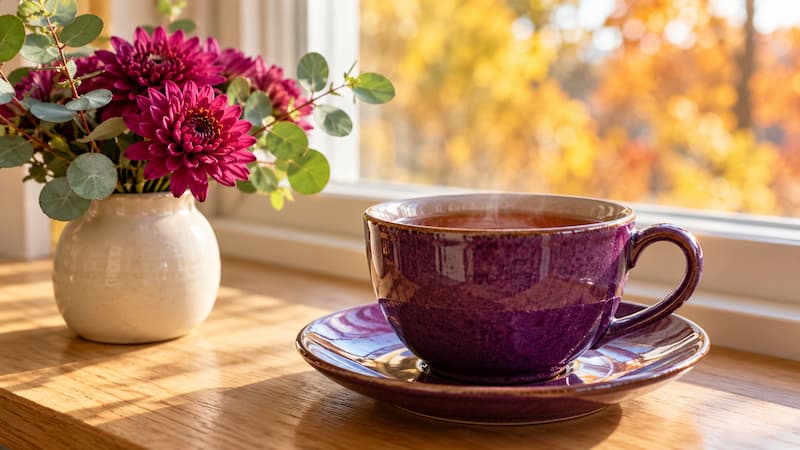
Perhaps someone remembered how you take your tea. Perhaps the late afternoon light caught your eye, or dinner was already in the freezer when you needed it.
You don’t have to turn the moment into a lesson. It can simply be something you liked.
I’m naturally in favour of giving a good cup of tea its due, but the moment doesn’t have to involve a mug. It might be a familiar song, a comfortable pair of shoes or a few minutes outside.
If writing helps, try one sentence: “Something I appreciated today was…”
One sentence is enough. You can also leave the notebook closed and enjoy the moment without recording it. November already has enough lists without gratitude insisting on one of its own.
3. Let a good moment be part of a difficult day
Sometimes enjoying yourself brings an unexpected flicker of guilt.
You laugh while someone you love is struggling. You enjoy an afternoon even though you’re grieving. You look forward to a gathering while another part of life remains uncertain.
It can feel as though a pleasant moment says something about how much you care. But a laugh doesn’t measure your love, and a quiet pleasure doesn’t erase what matters to you.
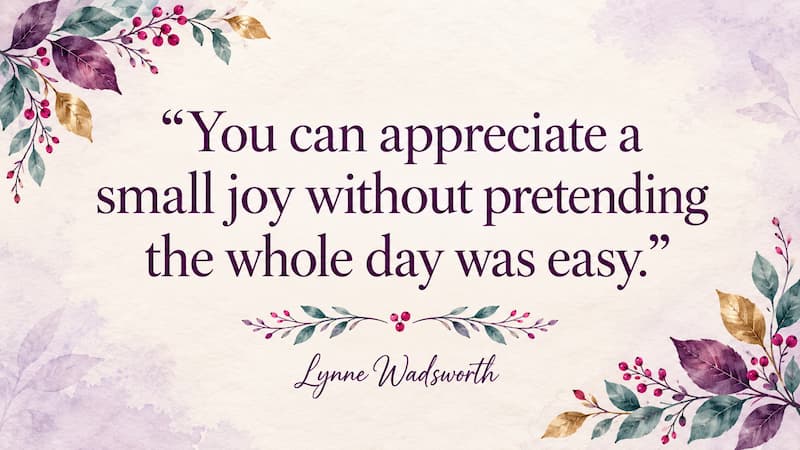
There can be room for a good moment within a day you wouldn’t choose to repeat.
Try describing it without making a claim about the whole day: “That conversation made me smile.” “I enjoyed being outdoors for a while.” “That meal was comforting.”
You’re allowed to leave the rest of the day exactly as it was.
And if you don’t want to look for a bright spot today, you can let that be true as well. A gentle invitation should leave you free to decline it.
4. Appreciate people without taking on every request
Being thankful for someone doesn’t mean you must be available for everything they ask.
You can value your family and ask for help with te meal. You can appreciate an invitation and leave early. You can love seeing people and need a quiet evening afterwards.
This matters when gratitude starts sounding like an obligation: “They’ve been so good to me; I can’t possibly say no.”
Consider what you can offer willingly. Be specific about that, rather than agreeing to more and hoping you’ll somehow find the energy.
“I’d love to join you for lunch. I’ll need to head home by three.”
“Thank you for inviting us. Could I bring something ready-made this time?”
“I’d really enjoy seeing you. A shorter visit would work better for me this week.”
You don’t have to include a speech defending your decision. Warmth and clarity can share the same sentence.
Leaving space for your own needs can make it easier to enjoy the time you do spend together.
5. Choose how much tradition fits this year
Growing up in England, I didn’t celebrate Thanksgiving. We celebrated Harvest Festival, so Thanksgiving was unfamiliar when I first came to the United States. It took time to feel connected to a holiday I hadn’t grown up with. After so many years here, the traditions now feel like second nature.
That experience reminds me that our relationship with a season can change. Something unfamiliar can become meaningful, and something familiar may need a different shape as our lives change.
Perhaps a favourite recipe still matters to you, but preparing the whole meal doesn’t. Perhaps you’d enjoy sharing a story about someone you miss. Or perhaps you’d rather have an ordinary, quiet day.
Ask yourself what you want to keep, what you could share with someone else and what you’d be comfortable leaving for another year.
A tradition can be meaningful without being repeated in every detail. There’s room to honour what it means to you while choosing what fits your circumstances now.

6. Make appreciation specific and personal
If you want to express gratitude, you don’t need an impressive message or a public announcement.
Think about what the person actually did and why you appreciated it.
“Thank you for checking in. It was lovely to hear a familiar voice.”
“I appreciated you sorting out dinner. Being able to sit down for a while made such a difference.”
“You made me laugh when I needed it. I’m glad we had that conversation.”
A private message can be enough. So can a few words while you’re washing up together or saying goodbye.
Let your appreciation belong to the person and the moment. You don’t need to compare your situation with someone who has less, or minimise a difficulty to prove you’re thankful.
You might also acknowledge something you did for yourself. Perhaps you asked for company, changed an unrealistic plan or made a meal when you were tired.
“I’m glad I gave myself that time” is something worth being able to say.
7. Keep the invitation gentle tomorrow too
You don’t need to finish November with an unbroken streak of gratitude entries.
Some days you’ll notice small pleasures easily. On others, you may be occupied with getting through what needs your attention. Missing a day doesn’t create a debt to catch up on.
If you’d like a simple way to pause, choose whichever question feels useful:
- What felt comforting today?
- Who helped make something easier?
- What would I like a little more of tomorrow?
You can answer one, think about it for a moment or save it for another day. If the question leaves you feeling judged, change the question.
And if what comes up is a need rather than a grateful thought, listen to that too. Perhaps the useful next step is asking someone to keep you company, sharing a task or making space for a proper rest.
Appreciating your life can include paying attention to what would help you live it more comfortably.
A little room for the whole of you
As Thanksgiving approaches here in the U.S., you may feel excited, reflective, lonely or several things within the same afternoon.
You may not celebrate it at all.
Whatever this part of November means to you, there’s room for your experience here.
Perhaps today you’ll notice something you appreciate. Perhaps you’ll tell someone they made a difference. Perhaps you’ll decide that what you need most is a quieter evening and a conversation with someone who listens.
Choose the invitation that feels kindest and most useful to you. A small pleasure can remain small and still be worth enjoying.
🍂 Your Free Season to Savor Companion

If you’d like a little encouragement along the way, my free six-page A Season to Savor guide brings together simple nourishment, meaningful connection and everyday gratitude.
You’ll find gentle reflections, practical ideas for sharing the workload and a flexible seven-day invitation to enjoy everyday pleasures. Choose a page that speaks to you and use it at your own pace.
Download your free A Season to Savor guide below.
What’s one small thing you’ve appreciated lately, even if life has felt complicated?
Come Join Us This November

You Don’t Have to Navigate Midlife Alone
If you’d love a little encouragement to care for yourself as the holiday season gathers pace, I’d love to welcome you into the Energized Healthy Women’s Club.
It’s a warm, private community for women 40+ where we share practical wellness ideas, honest conversations and support for the everyday realities of midlife—from energy and hormones to sleep, nourishment, stress and movement.
This November, we’re enjoying A Season to Savor. 🍂
We’re making room for simple nourishment, meaningful connection and everyday gratitude—with comforting recipes, small autumn pleasures and realistic ways to enjoy the season without putting ourselves last.
Think easier meals, a proper conversation, a little breathing room and noticing something lovely before rushing on to the next thing. Gratitude will be woven throughout, with space for whatever this time of year brings up for you.
Come as you are, bring your questions and join in whenever you wish. There’s always room for another woman at our virtual kitchen table—and, naturally, a cup of tea. 😊💜
Join us inside the Energized Healthy Women’s Club