
Have you ever woken up after what should have been a decent night’s sleep and thought:
Why am I still tired?
Or maybe you start the morning reasonably well, only to hit that familiar wall somewhere around 2 or 3 in the afternoon.
Suddenly you’re reaching for another cup of coffee, looking for something sweet, or wondering whether it’s socially acceptable to crawl under your desk for a nap. 😉
If you’re over 40, it can be tempting to blame every dip in energy on hormones or menopause.
And yes, hormonal changes during perimenopause and menopause can absolutely affect how we feel—particularly when hot flashes, night sweats, mood changes or disrupted sleep enter the picture.
But fatigue is rarely as simple as one hormone or one missing supplement.
Your energy is influenced by the whole picture:
- What you’re eating.
- How you’re sleeping.
- How you’re moving.
- How much stress you’re carrying.
- How much mental space you have.
- How often you’re giving to everyone else.
- And whether you’re ever truly allowing yourself to recover.
So instead of immediately asking:
“What can I take to give me more energy?”
I’d like you to consider a different question:
“What’s quietly taking my energy away?”
You might be surprised by the answer.
Here are seven hidden energy drains worth looking at.
1. You’re Sleeping… But You May Not Be Resting
There’s a difference between being in bed for eight hours and getting eight hours of restorative sleep.
Perhaps you’re falling asleep easily but waking several times.
Maybe night sweats are disturbing you.
Maybe you wake at 1:30 or 3 a.m. and suddenly your brain decides it’s the perfect time to think about absolutely everything.
I’ve certainly experienced those middle-of-the-night wake-ups myself.
And there’s something especially frustrating about lying there thinking:
“If I don’t fall asleep soon, I’m going to be exhausted tomorrow.”
Which, of course, is incredibly relaxing. 😉
Sleep disturbances can become more common for some women during the menopause transition. Hot flashes and night sweats can play a role, but they’re not the only possible reasons for disrupted sleep.
Before assuming you’re simply “bad at sleeping,” look at your patterns.
Ask yourself:
- Am I going to bed at roughly the same time most nights?
- Am I scrolling or working right up until bedtime?
- Am I having caffeine later in the day?
- Is alcohol disrupting the quality of my sleep?
- Is my bedroom cool, dark and comfortable?
- Am I regularly waking and struggling to get back to sleep?
- Do I wake feeling refreshed—or as though I barely slept?
You don’t need a perfect bedtime routine.
But a little consistency can help create the conditions for better rest.
Try dimming the lights, stepping away from your phone a little earlier, creating a short wind-down ritual or simply going to bed when you’re tired instead of squeezing one more task into the day.
And if sleep problems are persistent, severe or interfering with daily life, please bring them up with your healthcare provider. You don’t have to automatically accept poor sleep as “just part of getting older.”
2. You’re Running on Coffee Instead of Nourishment

I love a cup of tea—and I’m certainly not here to take away anyone’s morning coffee!
But caffeine can’t replace nourishment.
One pattern I see frequently is something like this:
Coffee for breakfast.
A rushed or very light lunch.
Then by mid-afternoon…
CRASH.
You’re tired.
You’re hungry.
Your concentration has disappeared.
And suddenly the biscuit, chocolate, chips or whatever happens to be nearby is calling your name.
That’s not necessarily a lack of willpower.
Your body may simply be asking for fuel.
Meals that combine protein, fiber-rich carbohydrates, colorful produce and healthy fats tend to be more satisfying than grabbing something highly refined on its own.
That could look like:
- Greek yogurt with berries, walnuts and seeds.
- Eggs with vegetables and whole-grain toast.
- A hearty lentil soup.
- Chicken with roasted vegetables and quinoa.
- An apple with nut butter.
- Hummus with vegetables and whole-grain crackers.
Nothing fancy.
Nothing “diet.”
Just food that actually nourishes you.
And don’t forget hydration.
Even your water bottle doesn’t need a complicated wellness strategy.
Sometimes the simplest question is:
Have I eaten enough today—and have I had anything to drink besides coffee?
3. Your Brain Has 37 Tabs Open

You can spend the entire day sitting at a desk and still finish it completely exhausted.
Why?
Because physical activity isn’t the only thing that uses energy.
Mental load does too.
Remembering appointments.
Planning meals.
Managing work.
Checking on family.
Thinking about aging parents.
Remembering birthdays.
Scheduling appointments.
Answering messages.
Making decisions.
Replaying yesterday’s conversation.
Worrying about tomorrow.
And somewhere in the background:
What are we having for dinner?
It’s like having 37 browser tabs open in your brain—and you’re not entirely sure which one is playing the music. 😉
This constant mental activity can leave us feeling depleted even when we haven’t done anything physically strenuous.
One of the simplest things you can do is stop requiring your brain to store everything.
- Write things down.
- Use a calendar.
- Make tomorrow’s short priority list before you finish today.
- Turn off notifications you don’t actually need.
- Give yourself periods when you’re not consuming information.
- And occasionally sit with your tea (r coffee) without also checking your phone, watching television and answering an email.
Your brain deserves a little breathing room too.
4. You’re Saying Yes With Energy You Don’t Actually Have
This one can be sneaky.
You might be eating well.
Sleeping reasonably well.
Exercising.
Drinking your water.
Doing all the “healthy” things…
and still feel completely depleted.
Take a look at your calendar.
How much of your energy is already promised to other people?
Women are often very good at being dependable.
- We help.
- We organize.
- We remember.
- We volunteer.
- We step in.
- We take care of people.
And those can be beautiful things.
But there is a difference between giving from a place of love and continually giving from an empty tank because you feel guilty saying no.
Every yes costs something.
- Time.
- Attention.
- Mental space.
- Physical energy.
Sometimes the answer to low energy isn’t adding another supplement or wellness routine.
It’s removing one obligation.
Try giving yourself a little space before automatically saying yes.
Something as simple as:
“Let me check my schedule and get back to you.”
can be incredibly useful.
You don’t need to explain yourself immediately.
You don’t need to decide on the spot.
And you don’t need to earn rest by first becoming completely exhausted.
5. You’re Moving Too Little—or Expecting Too Much From Exercise
Movement is interesting because both extremes can leave us feeling off.
When we’re tired, movement may be the last thing we want to do.
But spending most of the day sitting can leave us feeling stiff, sluggish and even more tired.
The answer doesn’t have to be a punishing workout.
✔️A short walk counts.
✔️Stretching counts.
✔️Gardening counts.
✔️Dancing in your kitchen counts.
✔️A few strength exercises count.
You don’t have to exercise for an hour before your body recognizes that you moved.
But there’s another side to this.
If you’re exhausted, sleeping poorly, under-fueled and stressed—and you’re forcing yourself through intense workouts because you believe harder is always better—that may not be the most supportive approach either.
Midlife is a wonderful time to shift the question from:
“How many calories can I burn?”
to:
“What kind of movement will help me stay strong, capable and energized?”
▫️Strength work matters.
▫️Walking matters.
▫️Mobility matters.
▫️And recovery matters too.
The best movement plan isn’t the one that leaves you feeling punished.
It’s the one you can realistically continue and that helps support the life you want to live.
6. You’re Stopping—But You’re Not Actually Resting

Here’s a question:
What do you do when you rest?
If the answer is…
- Scroll social media.
- Check email.
- Catch up on messages.
- Watch television while folding laundry.
- Read the news.
- Answer one more work question.
…your body may have stopped moving, but your brain hasn’t necessarily stopped working.
We’ve become very good at confusing inactivity with restoration.
True rest can look different for everyone.
It might be:
- Reading a book.
- Sitting outside.
- Listening to music.
- Having a bath.
- Taking a gentle walk.
- Praying or meditating.
- Doing something creative.
- Spending time in nature.
- Enjoying a cup of tea without doing anything else at the same time.
- Talking to someone who makes you laugh.
The important question is:
What leaves me feeling restored afterward?
Because if your version of “relaxing” consistently leaves you more agitated, distracted or drained, it may be time to experiment with something different.
Rest isn’t laziness.
Recovery is part of how we support energy.
7. You’ve Taken Joy Off Your Wellness List
This might be the energy drain nobody expects.
When did wellness become so serious?
- We’re tracking our steps.Watching our protein.
- Trying to sleep better.
- Reading labels.
- Managing stress.
- Taking supplements.
- Scheduling appointments.
- Planning meals.
And somewhere in all that “healthy living,” we can forget something rather important:
We’re supposed to enjoy our lives too.
Think about what makes you feel more like yourself.
🌿Music?
🌿Gardening?
🌿Books?
🌿Cooking?
🌿Travel?
🌿Being near the water?
🌿Playing with your grandchildren?
🌿Meeting a friend for tea?
🌿Dancing?
🌿Painting?
🌿Walking in nature?
🌿Laughing until your stomach hurts?
These aren’t frivolous extras that you get to have once you’ve completed every responsible thing on your list.
Connection, enjoyment and purpose are part of wellbeing too.
Ask yourself:
What gives me energy simply because I love it?
And then ask the harder question:
When did I last make room for it?
Maybe you don’t need another thing to accomplish.
Maybe you need something to look forward to.
But What If You’re Doing “Everything Right” and You’re Still Exhausted?
This is important.
Please don’t assume that persistent fatigue is simply because you’re over 40, going through menopause or failing to take good enough care of yourself.
Fatigue can have many causes.
For example, anemia can cause tiredness and weakness, and sleep disorders or other health conditions may affect how rested you feel.
Medication can sometimes play a role too.
So if your fatigue is:
• New or unexplained
• Persistent
• Becoming worse
• Affecting your ability to function normally
• Accompanied by symptoms that concern you
please have a conversation with your healthcare provider.
And don’t be afraid to advocate for yourself.
You know when something feels different in your body.
You deserve to have your concerns taken seriously.
Try an Energy Edit Instead of Another Overhaul
If you’re tired, your first instinct may be to fix everything.
New diet.
New workout.
New sleep routine.
New supplements.
New morning routine.
Monday morning—here we come!
But what if you didn’t?
What if you simply became curious?
For the next few days, notice:
What drains me?
What restores me?
When does my energy drop?
When do I feel most like myself?
What does my body seem to be asking for?
Then choose one small adjustment.
Perhaps you eat a more substantial breakfast.
Take a ten-minute walk after lunch.
Put your phone away earlier.
Say no to one thing.
Go to bed thirty minutes earlier.
Make a pot of nourishing soup so lunch is already handled tomorrow.
Call the friend who always makes you laugh.
Sit outside with your tea.
Small doesn’t mean meaningless.
Small means you might actually do it again tomorrow.
Your Energy Is Information
One of the most important shifts we can make in midlife is to stop treating our bodies as something we need to control and start becoming curious about what they’re telling us.
Low energy isn’t a moral failing.
And it doesn’t automatically mean you need more discipline.
- Sometimes your body needs nourishment.
- Sometimes it needs movement.
- Sometimes it needs better sleep.
- Sometimes it needs medical attention.
- Sometimes it needs a boundary.
And sometimes…
it needs an afternoon with absolutely nowhere to be.
Instead of asking:
“What’s wrong with me?”
try asking:
“What might I need?”
That’s a much kinder—and often much more useful—place to begin.
Come Join Us This October

You Don’t Have to Navigate Midlife Alone
If you’re craving practical wellness support, honest conversation and a community of women who understand that midlife can sometimes feel like a lot, I’d love to welcome you inside The Energized Healthy Women’s Club.
It’s a warm, private community for women 40+ where we talk openly about energy, hormones, sleep, nourishment, stress, movement, healthy aging—and all those everyday things that can affect how we feel in this season of life.
This October, we’re doing an Energy Edit. 🍂
We’re looking at what may be quietly draining our energy, what helps restore it, how seasonal nourishment can support us, and the small, realistic shifts that can help us feel more energized and more like ourselves—without trying to overhaul our entire lives.
There’s no pressure to have it all figured out. Come as you are, bring your questions, experiences and wonderfully imperfect self.
We’d love to have you with us. 💜
Join us inside the Energized Healthy Women’s Club here: https://www.facebook.com/groups/energized.healthy.women
💜 Ready to Discover Where Your Energy Is Going?💜
🍂 Where is your energy actually going?
Sometimes we think the answer to feeling better in midlife is to do more.
Eat better. Exercise more. Sleep better. Get more organized. Reduce stress…
Before long, taking care of ourselves has become another full-time job. 😉
But what if you started somewhere simpler?
💜 What’s draining me?
💜 What restores me?
💜 What does my body need more of right now?
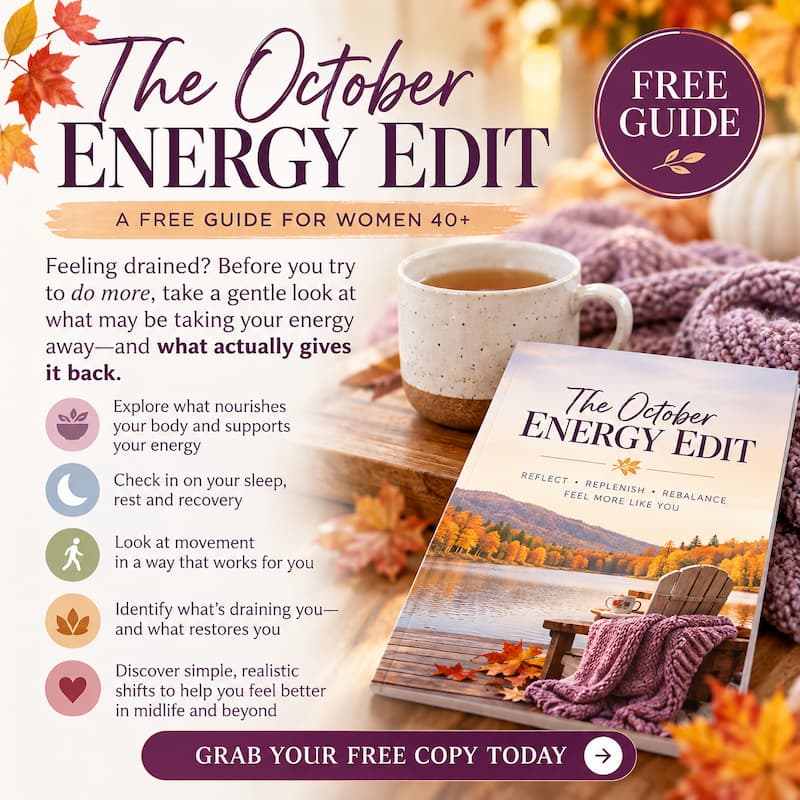
I created my October Energy Edit to help you do exactly that.
This free guide will help you take a gentle look at the different areas affecting your energy—from nourishment and sleep to stress, movement, boundaries, connection and joy—and decide where a few small changes might make life feel a little better.
✨ No perfection required.
✨ No complicated wellness plan.
✨ No trying to change everything at once.
Just a little time to check in with you.
🍂 FREE: The October Energy Edit
Use it throughout the month or sit down with a cup of tea and work through it at your own pace.
👉 Grab your free copy here: holistic-health-wellness-llc-ibcqqr.subscribepage.io
And if you know another woman who’s been running on empty lately, feel free to share this with her too. 💜