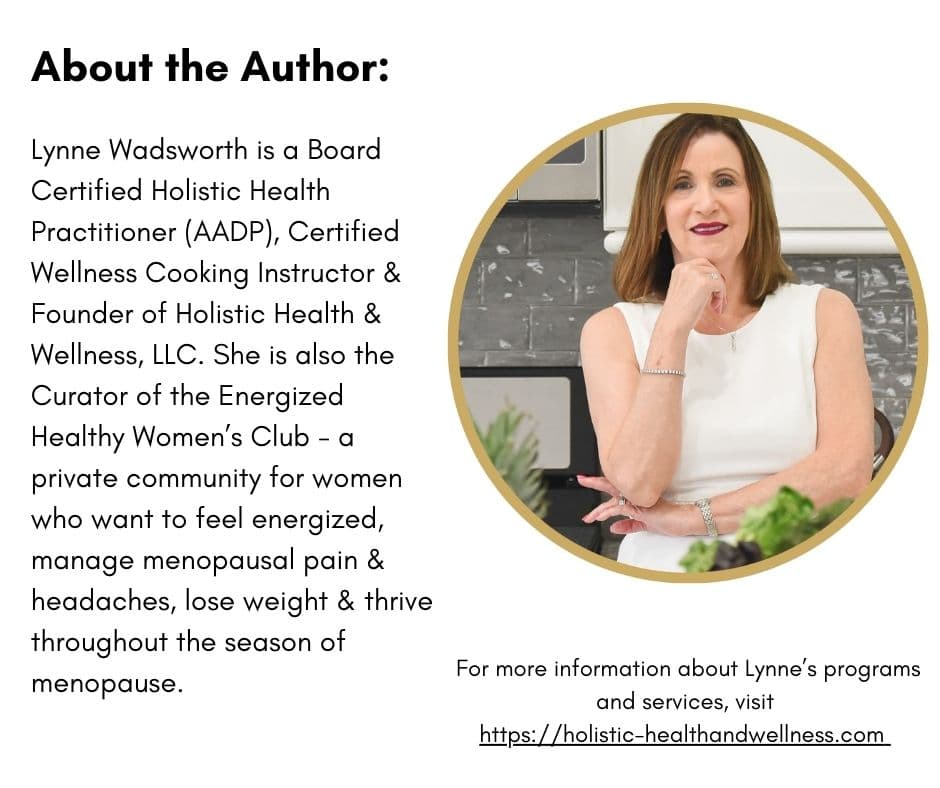
When you hear the words “healthy aging,” what comes to mind?
Perhaps it’s a woman with flawless skin, expensive workout clothes and a refrigerator containing seventeen carefully labeled glass containers.
She’s already meditated, journaled, exercised, prepared an organic green smoothie and organized her spice drawer—and it’s only 7:12 in the morning.
Meanwhile, some of us are still wandering around looking for the cup of tea we made ten minutes ago!
Healthy aging is often presented as though it’s another full-time job. We’re given long lists of foods to avoid, supplements to take, exercises to complete and routines to follow. And if we can’t manage all of it perfectly, we may wonder whether we’ve somehow failed.
But healthy aging doesn’t require perfection.
It isn’t about fighting your age, trying to become the woman you were at 25 or attempting to stop every wrinkle from appearing. It’s about supporting yourself from the inside out so you can continue participating fully in your own life.
It’s about having the strength to do the things that matter to you, enough energy to enjoy them and the confidence to make choices that support the woman you are becoming.
My Own Inside-Out Approach to Aging
My understanding of healthy aging didn’t come from following one perfect plan. Much of it came from learning to listen to my body through some very challenging seasons.
For years, migraines had an enormous impact on my life. They became so frequent and debilitating that there were times when I needed injections at a migraine clinic just to cope.
When pain becomes part of your daily life, it can begin to shrink your world. You make plans cautiously. You wonder whether you’ll have the energy to follow through. You become accustomed to working around your symptoms rather than genuinely feeling well.
As I learned more about holistic health and began making changes to my diet and lifestyle, particularly by focusing on more anti-inflammatory foods, my migraines improved dramatically. I still experience weather-related triggers—Florida’s barometric pressure occasionally likes to remind me who’s in charge—but they no longer dominate my life in the same way.
That experience taught me something important: caring for ourselves as we age isn’t primarily about what other people can see.
It’s about what begins to change within us when we nourish ourselves, pay attention to our bodies, ask better questions and make supportive choices consistently.
My journey has also included endometriosis, a hysterectomy and later surgery to remove my ovaries. There have been times when my body has required patience, advocacy and a willingness to adjust. I haven’t always enjoyed those lessons, but they’ve helped me appreciate my body as a partner—not a project that constantly needs correcting.
Healthy aging, for me, means continuing to learn what helps me feel strong, energized, curious and fully engaged with life.
Here are seven ways you can begin doing the same.
1. Change the Conversation You’re Having With Yourself About Aging
The words we use matter.
How often do we hear ourselves or other women say:
- “I’m too old for that.”
- “Everything falls apart after 40.”
- “I suppose this is just what happens now.”
- “There’s no point starting at my age.”
Some physical changes are part of aging, but that doesn’t mean every symptom should be dismissed or that growth has an expiration date.
The stories we repeatedly tell ourselves can affect the choices we make. If you believe decline is inevitable, you may stop exploring what could help you feel better. You may accept exhaustion, discomfort or disconnection without asking whether additional support is available.
Try changing the question from:
“What’s wrong with me now?”
to:
“What might my body need from me now?”
That small shift moves you from criticism to curiosity.
You’re not pretending that everything is wonderful. You’re simply leaving room for possibility.
Try this today:
Notice one discouraging statement you make about your age. Replace it with something more supportive and truthful:
- “I’m learning what works for my body now.”
- “It’s not too late to become stronger.”
- “I can begin with one small step.”
- “My age doesn’t disqualify me from feeling well.”
You do not have to stand in front of the mirror chanting affirmations until your family becomes concerned. Just begin speaking to yourself as you would speak to a woman you genuinely care about.
2. Build Strength in Small, Realistic Ways
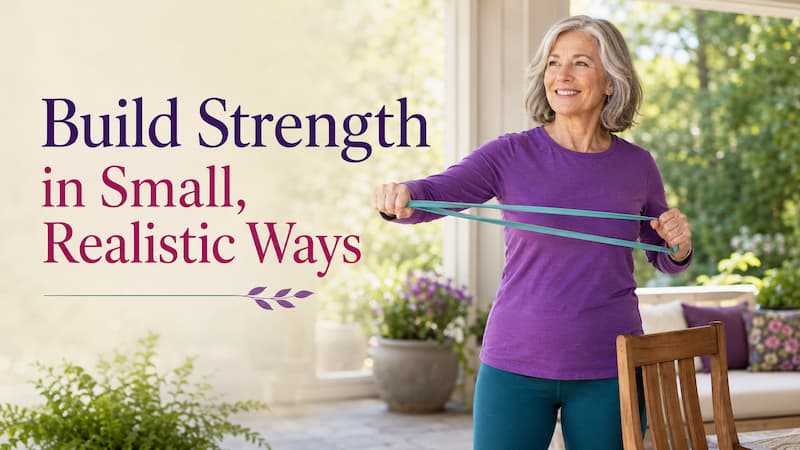
Strength is about far more than how much weight you can lift.
It helps you carry groceries, climb stairs, get up from the floor, maintain your balance, travel, garden and keep doing everyday activities independently.
The National Institute on Aging notes that aerobic, muscle-strengthening and balance activities can all contribute to health and physical function as we age. Current activity guidelines also recommend muscle-strengthening exercise at least twice each week—but that doesn’t mean you have to transform your garage into a private gym. National Institute on Aging and CDC.
Growing up in England, walking was naturally woven into everyday life. We walked to get somewhere—not necessarily because a watch was tracking us, sending encouraging vibrations and awarding us a digital badge afterward.
That’s a reminder that movement doesn’t have to be elaborate to count.
You can build strength through:
- Standing up from a chair several times
- Carrying grocery bags
- Using resistance bands
- Lifting light hand weights
- Gardening
- Walking up stairs
- Performing wall push-ups
- Practicing balance near a sturdy counter
- Taking a brisk ten-minute walk
Try this today:
Choose one five-minute “strength snack.”
For example, complete ten chair stands, ten wall push-ups and a short walk around your home. Begin at a level that feels appropriate for your body and build gradually.
You don’t have to train for a marathon—unless you genuinely want to, in which case I’ll cheer for you from a comfortable chair.
If you’ve been inactive or have a health condition, injury or balance concern, speak with your healthcare professional before beginning a new exercise program.
3. Nourish Yourself Instead of Punishing Yourself
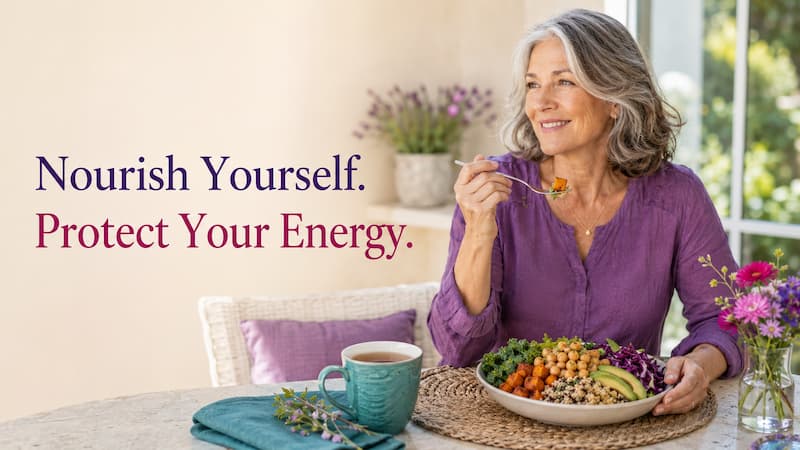
Many women have spent years moving from one restrictive diet to another.
We’ve counted calories, removed food groups and tried plans that required special ingredients available only from a tiny shop halfway up a mountain.
But nourishment asks a different question.
Instead of asking, “What should I take away?” ask:
“What could I add that would support my energy, strength and well-being?”
That may mean adding:
- A source of protein to breakfast
- More colorful vegetables
- Beans or lentils
- Berries or another fruit
- Nuts and seeds
- Supportive fats
- Water or herbal tea
- A simple homemade meal
Protein is especially important for maintaining and repairing body tissues. It can come from fish, poultry, eggs, dairy, beans, lentils, nuts, seeds, tofu and other soy foods. Variety matters more than finding one supposedly miraculous food. National Institute on Aging.
Try this today:
Look at one meal and ask, “What could I add to make this more nourishing?”
Perhaps it’s spinach in your eggs, berries with breakfast, lentils in your soup or walnuts on your salad.
Healthy aging doesn’t require a refrigerator that looks as though it belongs to a nutrition influencer. It requires enough supportive choices made often enough to make a difference.
4. Protect Your Energy Before You Completely Run Out of It
Many women have become exceptionally skilled at pushing through.
We care for our families, manage our work, remember birthdays, arrange appointments and somehow know where everyone else left their belongings.
Then, when we’re exhausted, we wonder why we can’t simply push a little harder.
Energy isn’t an unlimited resource. Protecting it may mean taking a break before you reach complete depletion, saying no to something that isn’t yours to carry or allowing yourself to rest without first completing every known task in the Western Hemisphere.
Rest isn’t laziness. It’s part of how the body recovers.
Try this today:
Create an “energy pause” somewhere in your day.
It could be:
- Five quiet minutes outside
- A cup of tea without your phone
- Gentle stretching
- Closing your eyes and breathing slowly
- Moving one nonessential task to another day
- Saying, “I can’t commit to that right now”
You don’t have to earn a pause. You’re allowed to support your energy before it disappears.
5. Keep Giving Your Brain Something New to Explore
Healthy aging isn’t only about supporting the body. Curiosity helps keep life interesting and expansive.
The National Institute on Aging encourages people to remain mentally and socially engaged. Activities such as music, dance, creative writing and other meaningful pursuits may support quality of life and well-being, although research into their long-term cognitive effects continues.
You don’t need to enroll in an advanced university course—although you certainly can.
You could:
- Read a book outside your usual genre
- Learn a new recipe
- Take up a hobby
- Listen to an educational podcast
- Learn a few words in another language
- Visit somewhere new
- Try a different walking route
- Ask someone to teach you something they enjoy
Try this today:
Choose one small act of curiosity.
Ask yourself, “What have I always wanted to learn, try or understand?”
Healthy aging includes remembering that you’re still becoming. There are still ideas to explore, people to meet and parts of yourself you haven’t discovered yet.
6. Become a Better Listener to Your Own Body
Your body communicates through patterns.
It may show you that certain foods affect your energy, that stress changes your digestion, that inadequate rest intensifies your cravings or that a particular symptom appears at the same point every month.
Listening doesn’t mean becoming frightened by every ache, twitch or unusual afternoon yawn. It means noticing changes without immediately dismissing them.
When I was struggling with migraines, learning to identify patterns helped me become a better advocate for myself. I began to understand that my symptoms weren’t random inconveniences; they were information.
Your body may communicate differently now, but it hasn’t suddenly become an unreliable nuisance simply because you’ve reached midlife or beyond.
Try this today:
Keep a simple note for one week recording:
- Your energy
- Your mood
- Your sleep
- Your movement
- Your meals
- Any recurring symptoms
You’re not trying to produce a medical dissertation. You’re looking for helpful connections.
If a symptom is new, persistent, worsening or concerning, speak with a qualified healthcare professional. “It’s probably just aging” should never be the end of the conversation when your body is telling you something has changed.
7. Keep Building a Life You’re Excited to Participate In
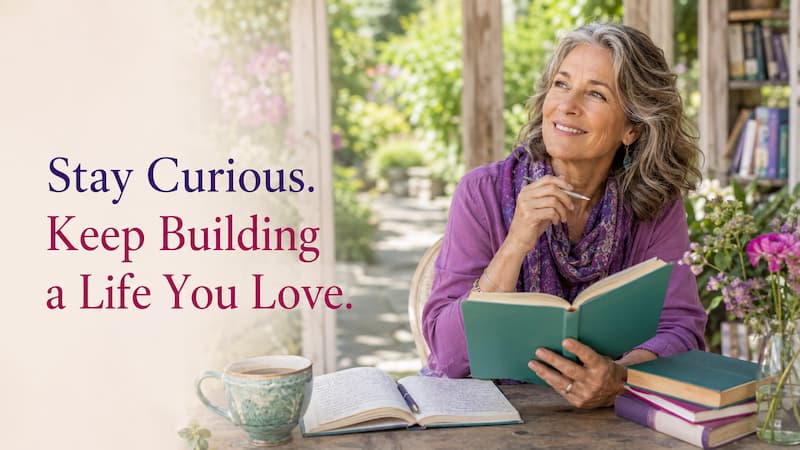
We sometimes talk about health as if its only purpose is to help us avoid illness.
But what are you caring for your health for?
Perhaps you want the energy to play with your grandchildren, travel with your husband, spend time in nature, grow your business, volunteer, create something beautiful or simply feel more present in your daily life.
Purpose doesn’t have to be a grand mission. It can be having something meaningful to contribute and something enjoyable to anticipate.
Research summarized by the National Institute on Aging suggests that enjoyable and socially engaging activities may support well-being as we age.
Try this today:
Complete these two sentences:
- “I want to feel stronger and more energized so I can…”
- “One thing I’d love to look forward to is…”
Your answers give your healthy choices a personal reason.
A walk feels different when it’s connected to being able to explore on your next trip. Strength exercises feel different when you picture lifting a grandchild or carrying your own suitcase. Nourishing food feels different when it supports a life you genuinely want to live.
Healthy Aging Begins With One Supportive Choice
You don’t need to do all seven things today.
In fact, please don’t turn this blog into another list you use to judge yourself. That would rather defeat the purpose.
Choose one idea that feels supportive:
- Change one thought about aging.
- Take a five-minute walk.
- Add something nourishing to lunch.
- Protect ten minutes of your energy.
- Learn something new.
- Record a pattern you’ve noticed.
- Plan something you’ll enjoy.
Then repeat it.
Healthy aging is rarely the result of one dramatic decision. More often, it grows from small choices we return to consistently—especially after life interrupts our best intentions, as life has a habit of doing.
You aren’t too old.
You haven’t missed your opportunity.
And you don’t need to become someone else to age well.
You can care for the woman you are now while continuing to grow into the woman you’re becoming.
Come Join Us This September
You Don’t Have to Navigate Midlife Alone
If you’re craving practical wellness support, honest conversation and the reassurance that other women understand what you’re experiencing, come join us inside The Energized Healthy Women’s Club.
It’s a welcoming private community where women can talk openly about energy, hormones, sleep, nourishment, stress, healthy aging and the realities of life in midlife—without judgment or pressure to be perfect.
This September, we’re reimagining healthy aging through strength, joy, curiosity, connection and purpose.
Come as you are. Bring your questions, experiences and wonderfully imperfect self. We’d love to welcome you. 💜
👉 Join us inside the Energized Healthy Women’s Club here: https://www.facebook.com/groups/energized.healthy.women
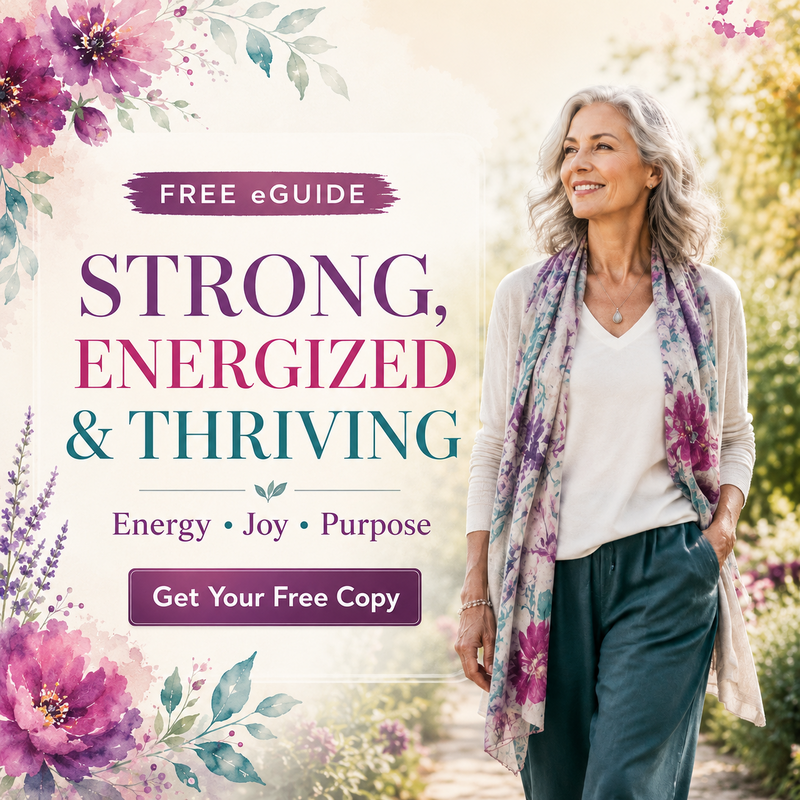
💜 Your Free Healthy-Aging Guide 💜
Healthy aging isn’t about trying to turn back the clock or become the woman you were 20 years ago.
It’s about supporting the woman you are today—with more energy, joy, confidence and curiosity for everything still ahead. 💜
That’s why I created my new free eGuide:
Strong, Energized & Thriving: A Midlife Woman’s Guide to Healthy Aging With More Energy, Joy and Purpose
Inside, you’ll find:
💜 A Midlife Energy Audit
💗 Five gentle ways to protect your energy
💚 A Personal Joy Menu
✨ A 7-Day Joy Spark Challenge
🧠 Practical ways to support memory and focus
🌿 Reflection pages for connection, curiosity and purpose
✅ A printable healthy-aging tracker
🥗 Three delicious recipes for midlife vitality
This isn’t another guide filled with rigid rules or a long list of things you’re supposed to do perfectly. It’s a warm, practical resource to help you notice what your body and mind need—and begin with one manageable step.
Ready to feel strong, energized and fully engaged in the life you’re living?